
Art & Creative Practices
Person-Centered Expressive Arts Groups
Creativity, Healing, Growth, and Transformation
For more than 15 years, I have designed and facilitated Person-Centered Expressive Arts groups across the United States and Europe, supporting personal development, executive growth, creativity, and emotional healing.

Professional references
Person-Centered Expressive Arts: Natalie Rogers and the PCEA approach - the tradition that informs my facilitation and teaching. Link
Associate faculty: Carl Rogers Institute - Partners Link
Doctoral research and book: Art and Self-Creation: The Roots of Creativity and Innovation. Atropos Press Link
Professional leadership: IEATA Board of Directors - my profile appears under the Artists Committee. Link

My work spans organizational and leadership development, experiential learning, and mental health groups, including groups serving adults experiencing significant mental health challenges.
My approach is rooted in the teachings of Dr. Natalie Rogers, pioneer of Person-Centered Expressive Arts Therapy. I completed her certificate training in 2008 and subsequently served as associate faculty, teaching her approach. At the heart of this work is the creation of a safe, accepting, nonjudgmental space where people can explore their experiences and discover their own insights through movement, visual art, writing, sound, and other creative processes.
Rather than interpreting people's artwork or prescribing what they should discover, I trust their capacity to find personal meaning through creative exploration. The emphasis is on the process, not artistic ability or the finished product. This approach can support self-awareness, emotional expression, resilience, connection, and new possibilities for change.
My work has extended from helping executives and teams navigate complexity, ambiguity, and transformation to facilitating experiential groups for adults dealing with trauma, anxiety, depression, and suicidal ideation. In mental health settings, I adapt creative processes to participants' needs and the clinical context, complementing the broader goals of care.
I hold a Ph.D. from the European Graduate School, where my research explored how expressive arts support decision-making and meaning-making in complex situations. My dissertation became the foundation for my book, Art and Self-Creation: The Roots of Creativity and Innovation, published by Atropos Press. I am a Registered Expressive Arts Consultant and Educator (REACE®) and serve on the Board of Directors of the International Expressive Arts Therapy Association (IEATA).
Across these different settings, my purpose remains consistent: to create opportunities for people to reconnect with their creativity, deepen their understanding of themselves, and discover new ways of engaging with life.

Art Allowed me to Heal and Thrive
Person Centered Expressive Arts Therapy

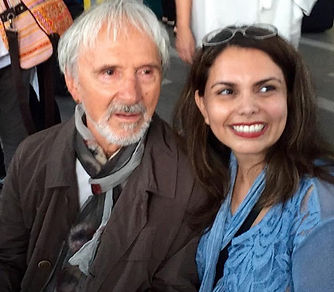
In the two photos above are my teachers Dr. Natalie Rogers and Dr. Paolo Knill. I had the privilege of studying directly with Dr. Natalie Rogers and I am associate faculty in Person-Centered Expressive Arts Therapy. https://www.carlrogersphd.com/partners
I also studied directly with Dr. Paolo Knill, earning my doctorate at the European Graduate School (EGS). My dissertation on the impact of expressive arts on decision-making became the foundation for my book Art and Self-Creation: The Roots of Creativity and Innovation, published by Atropos Press. With the support of EGS and the International Schopenhauer Association, Atropos continues to champion bold and imaginative voices in art and philosophy. Art and Self-Creation: The Roots of Creativity and Innovation — Atropos Press
Currently, I am privileged to bring the healing power of Person-Centered Expressive Arts Therapy to diverse groups, from high-acuity clients to corporate teams, through leading mental health providers across the United States. I am also a Registered Expressive Arts Consultant and Educator, REACE, and serves at the Boad of Directors at the International Expressive Arts Therapy Association IEATA

Creating my own art is a pivotal practice that helps me process the personal impact of my therapeutic work with clients.
Also, creating my own art is how I explore the connection between my inner world and life.
I enter the creative process with curiosity and uncertainty, allowing each painting to unfold spontaneously.